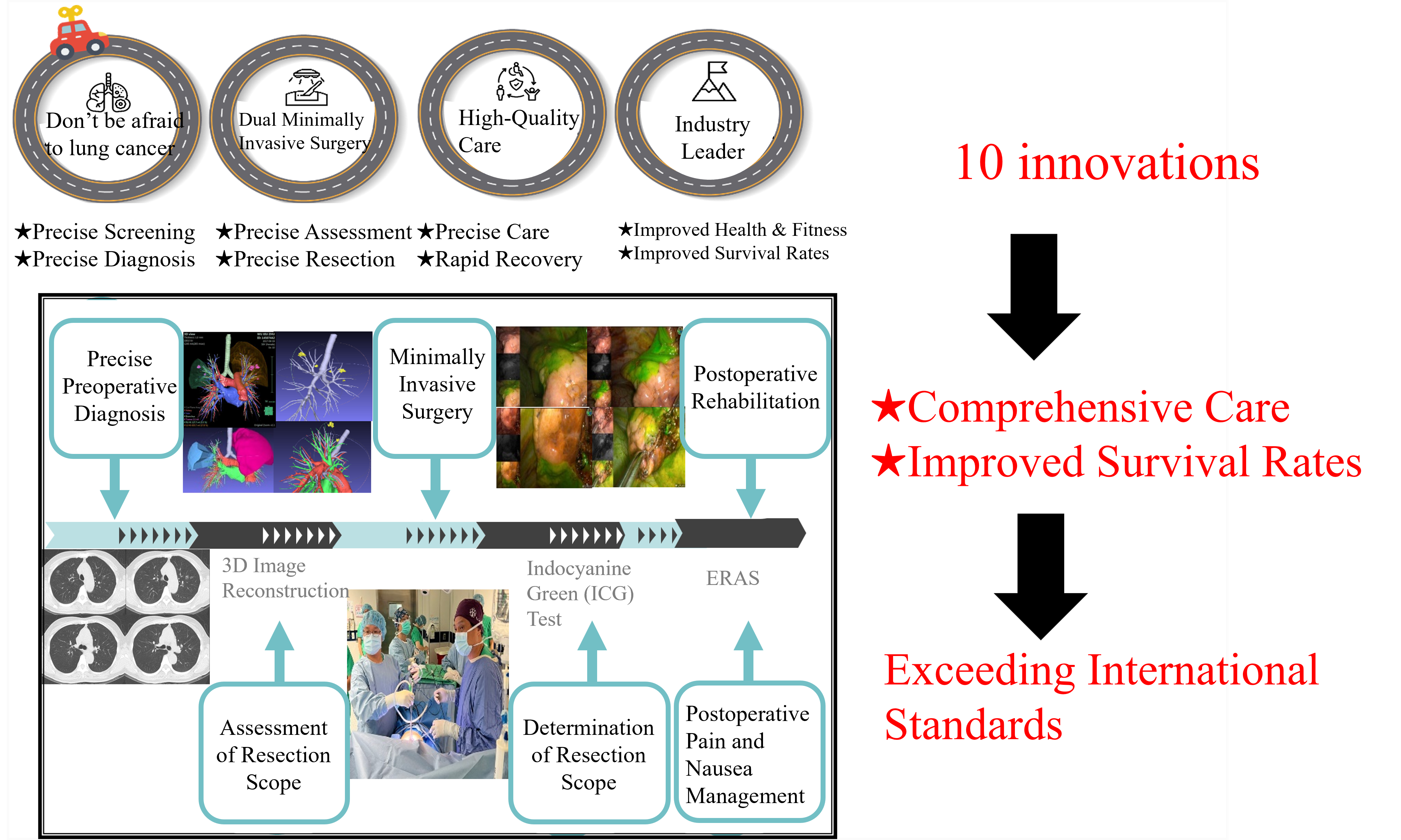
Our thoracic surgery team has developed an integrated “Precision Treatment in Lung Cancer Surgery: Minimally Invasive within Minimally Invasive” that combines AI-assisted imaging, 3D reconstruction, virtual navigation, hybrid operating rooms, and digital rehabilitation platforms to deliver a seamless, end-to-end care pathway from screening to long-term follow-up.
In community settings, dual-energy chest X-ray with AI interpretation allows rapid and accurate early detection. A federated learning framework further enhances model performance while preserving patient privacy. Preoperatively, Synapse 3D supports precise surgical planning. Intraoperatively, naked-eye 3D visualization and hybrid operating rooms help real-time localization. Uniportal minimally invasive surgery results in better accuracy and safety.
This system significantly reduces surgical invasiveness. It also shortens operative time and hospital stay averaging about four days. Diagnostic accuracy and postoperative recovery improves as well. After discharge, patients use an interactive, personalized rehabilitation platform with remote monitoring, reducing complications and readmission rates.
For patients, the system leads to less pain, faster recovery, and improved survival outcomes. For healthcare staff, AI-assisted workflows and standardized protocols reduce workload. They also enhance decision-making efficiency, care quality, and team coordination.
At the societal level, mobile screening programs extend services to rural and underserved areas. This reduces healthcare disparities and helps achieve national lung cancer screening targets ahead of schedule. International training programs and technology transfer further strengthen Taiwan’s global leadership in smart healthcare. They also advance minimally invasive thoracic surgery. This demonstrates significant clinical, social, and global impact.