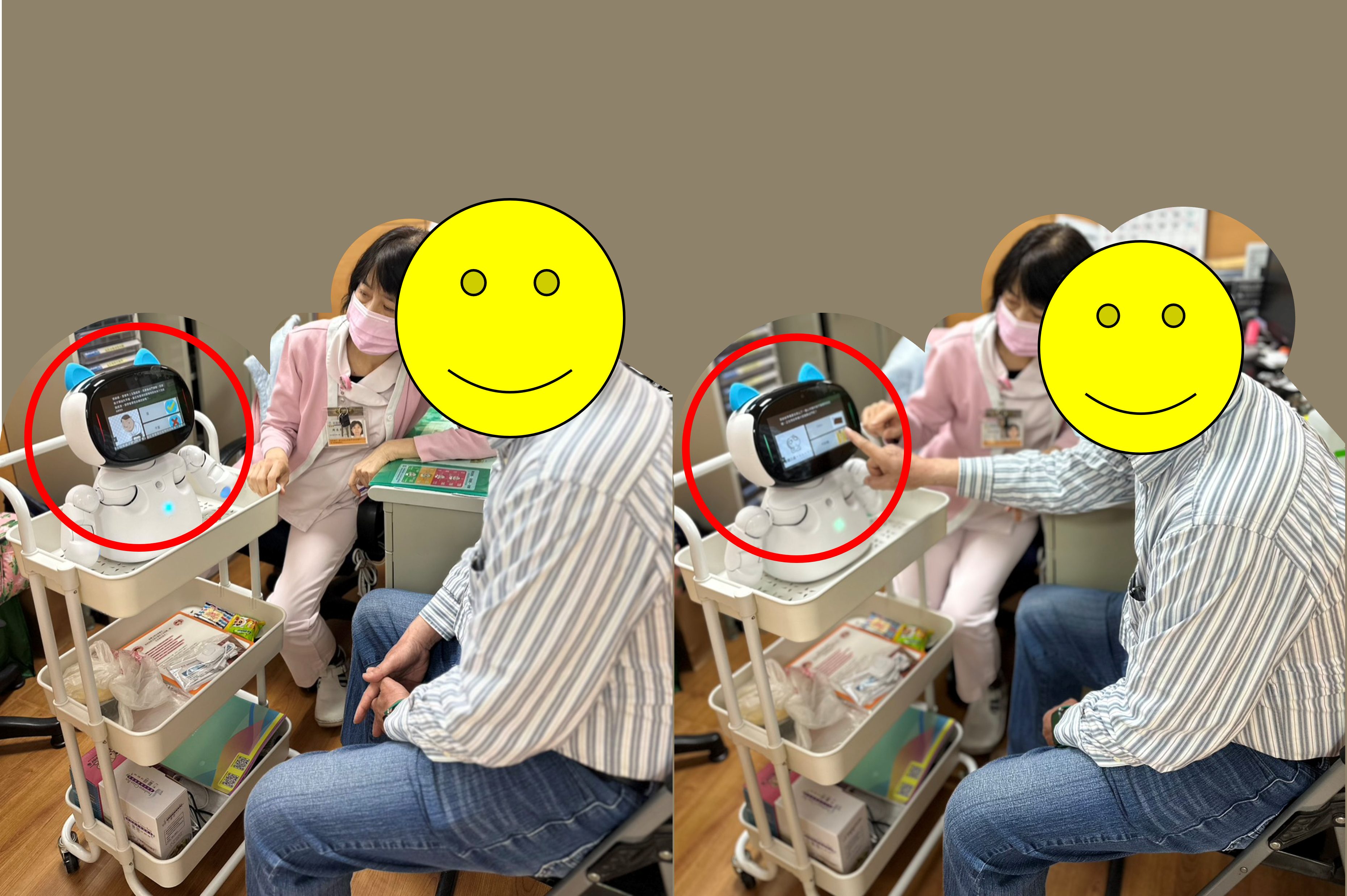
Robot-Assisted Health Education and Shared Decision-Making
LI-CHI CHEN, Director, NCKUH Douliu Branch Dept. of Nursing
To improve the quality of outpatient health education and promote patient participation in medical decision-making, National Cheng Kung University Hospital(NCKUH) Douliu Branch introduced a multimedia robot with voice, facial expressions, movement, and question-and-answer functions as an assistive tool for outpatient nursing education and Shared Decision-Making (SDM). Traditional health education mainly relies on verbal explanations and printed leaflets, which may result in inconsistent information delivery and limited patient understanding, due to time and manpower constraints. Through standardized and interactive education provided by the robot, patients and their families can better understand medical information and care options, thereby enhancing their ability to participate in decision-making.
Satisfaction was evaluated using a five-point Likert scale. The results showed that patients and family members reported relatively high overall satisfaction with robot-assisted health education. The average scores for course interest, attention, and knowledge acquisition were all above 4.13 (out of 5), indicating good acceptance. However, lower scores were observed for the naturalness of the robot’s movements (3.98) and for the willingness to continue using it in the future (3.75). The standard deviation of overall ratings ranged from 0.8 to 0.9, suggesting good consistency in responses. No significant association was found between satisfaction and demographic characteristics (age, gender, education level, and occupation). Due to the small number of nurse participants (N=4), statistical analysis was not conducted. Preliminary feedback indicated that nurses rated the system interface and stability as moderate, and the effectiveness of the robot in reducing teaching time and improving work efficiency remains to be further evaluated.
Overall, robot-assisted health education can enhance patients’ and family members’ motivation and engagement, with potential to support shared decision-making. Future efforts should focus on optimizing interactive design and system stability, and on strengthening training and support for nursing staff to improve clinical application outcomes.