An Accelerator for Big Data Research in Healthcare: Cheng Kung University Hospital Archive of Medical Record Data (CARD)
SHU-PING LIN, Informatics Engineer, Clinical Innovation and Research Center
CHIEN-CHOU SU,Assistant Research Fellow, Clinical Innovation and Research Center
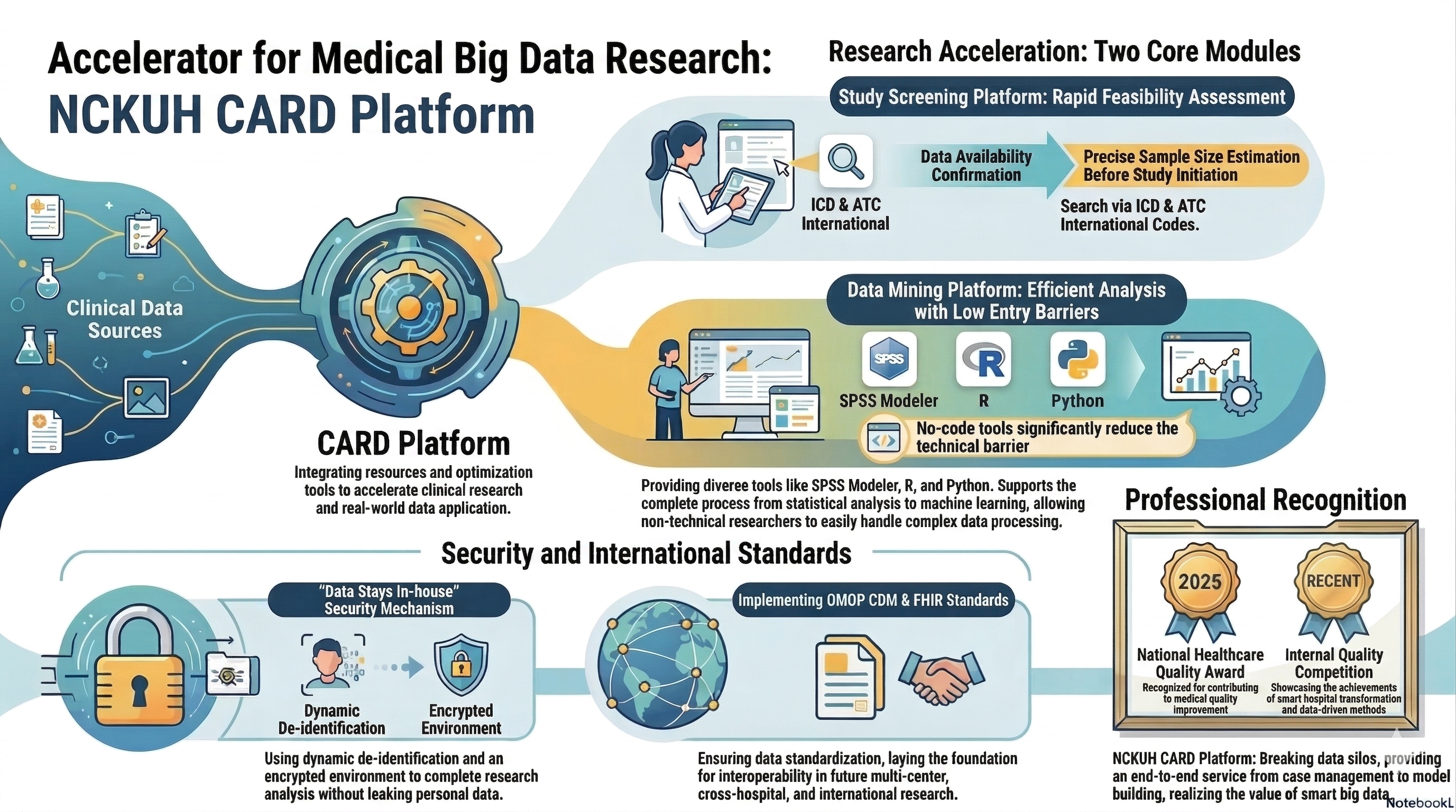
The Cheng Kung University Hospital Archive of Medical Record Data (CARD) is a centralized repository for integrating and analyzing medical record data. It was established to address several common challenges in clinical research, including fragmented healthcare data, information silos, difficulties accessing data, and the high technical barriers to big data analytics in medicine. By integrating diverse in-hospital data sources and analytical tools, CARD has become a key infrastructure for accelerating clinical research and real-world data applications.
The CARD platform consists of two major modules: a research screening platform and a data mining platform. The research screening platform enables investigators to quickly identify patient records and perform preliminary cohort screening using international standard coding systems, such as ICD and ATC. This process ensures that researchers can assess sample size early in study planning, thereby improving the efficiency of the research design. By clarifying data availability and reducing time spent on repeated cohort verification, this mechanism supports more informed and streamlined research design.
The data mining platform enables researchers to directly explore and analyze data within a secure environment. The platform Integrates analytical tools, such as SPSS Modeler (no-code), RStudio, and Python (Jupyter Notebook), supporting the full workflow from data processing to machine learning modeling and data visualization. This integration lowers technical barrier for diverse researchers and further enhances the flexibility and efficiency of data analysis.
To ensure data security and privacy, CARD employs dynamic de-identification and personal data masking mechanisms while adhering to the principle that data do not leave the platform. All analyses are conducted within an encrypted cloud-based secure environment, thereby minimizing the risk of personal data leakage while balancing research utility with information security requirements. This design enables the platform to provide a sustainable environment for medical data research that compiles with regulatory and ethical requirements.
In addition to integrating raw data from the hospital information system (HIS), CARD has also begun incorporating international data standards such as OMOP Common Data Model (OMOP CDM) and FHIR. This provides an important foundation for future cross-hospital, cross-system, and even international multicenter studies. It not only improves data standardization and interoperability but also helps align NCKUH’s research with international frameworks, thereby enhancing opportunities for global collaboration and academic visibility.
Reflecting the platform’s impact, CARD’s development and achievements have received broad recognition. In 2025, the platform received the National Healthcare Quality Award, and garnered multiple honors in internal quality improvement competitions at NCKUH. CARD has gradually become a representative example of smart hospital transformation and data-driven research innovation.
Overall, CARD has become a core platform for promoting real-world data analysis and clinical research at NCKUH. It has supported the publication of numerous journal articles and master’s and doctoral theses. In doing so, it continuously strengthens the hospital’s research capacity and advancing of biomedical research and the development of smart healthcare in Taiwan.